

Mexico has become one of the world’s more interesting — and controversial — battlegrounds over nicotine vaping.
Visitors sometimes encounter an apparent contradiction. People can be seen vaping in Mexican tourist destinations, yet ordering a nicotine vape from another country and having it delivered to Mexico can be another matter entirely.
Packages may be stopped, rejected or returned rather than reaching their intended destination.
So why is this happening?
The answer is Mexico’s increasingly restrictive approach toward electronic cigarettes and vaping products.
Mexico’s Changing Vape Laws
Mexico’s battle over vaping has been developing for years through presidential decrees, health regulations, court decisions and constitutional and legislative changes.
The direction of government policy, however, has been clear: Mexico has moved aggressively against the commercial market for electronic cigarettes and vaping products.
That distinction between seeing people vape and legally operating a commercial vape supply chain is important.
A product being widely used does not necessarily mean businesses are legally permitted to manufacture, import, distribute or sell it.
And that helps explain why travelers sometimes see vapes being used while simultaneously discovering that their own shipment cannot get through Mexico’s import system.
Why Are Vape Shipments Being Sent Back?
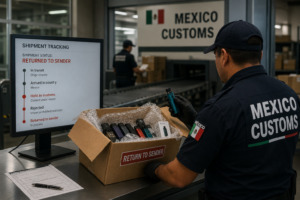
When a package enters Mexico from another country, it doesn’t simply move from the foreign seller to your doorstep.
It enters an import and customs system.
If that shipment contains merchandise whose importation or commercialization is prohibited or restricted, the package can encounter problems before it ever reaches the recipient.
Depending on the carrier and circumstances, a shipment containing vaping products may be detained, rejected, seized or returned.
That means the mysterious tracking update saying your package has suddenly reversed direction may have nothing to do with your address.
The contents of the package may be the problem
But Are Vapes Actually Worse Than Cigarettes?
This is where the debate gets considerably more interesting.
There is an important difference between saying vaping is safe and saying vaping may be less harmful than smoking combustible cigarettes.
Those aren’t the same claim.
Cigarettes burn tobacco. Combustion creates an enormous mixture of chemicals, including many responsible for smoking-related disease.
Electronic cigarettes work differently. They heat a liquid to create an aerosol rather than burning tobacco.
That doesn’t make vaping harmless.
But eliminating combustion is precisely why some researchers and public-health authorities have investigated vaping as a harm-reduction tool for existing smokers.
A major Cochrane systematic review examining evidence through March 2025 found that nicotine e-cigarettes helped more smokers quit for at least six months than traditional nicotine-replacement therapies such as patches or gum.
That is significant.
For an adult who already smokes cigarettes and completely switches to vaping, there may therefore be a meaningful harm-reduction argument.
For someone who doesn’t smoke, however, starting to vape provides no comparable benefit
The Case Against Vaping
There are legitimate reasons for concern.
Nicotine is highly addictive.
Vape aerosol can expose users to potentially harmful substances, and researchers are still studying the long-term consequences of regular vaping.
Youth vaping is particularly concerning because nicotine exposure during adolescence can affect the developing brain and establish addiction at a young age.
Product quality presents another issue.
Not every vape is manufactured to the same standards. Devices and liquids obtained through informal or illicit markets may present additional uncertainties about ingredients, nicotine concentration, manufacturing conditions and authenticity.
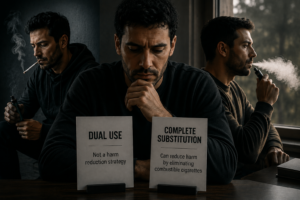
And using cigarettes and vapes simultaneously — known as dual use — shouldn’t automatically be considered harm reduction.
The strongest argument for vaping concerns adult smokers who completely replace cigarettes, not people simply adding another nicotine product to their lives.
The Case for Regulation Instead of Prohibition
This leads to one of the most interesting questions surrounding Mexico’s policy.
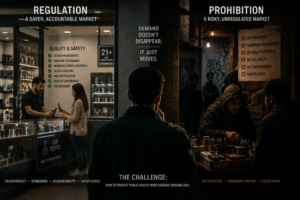
If adults continue demanding nicotine vapes despite prohibition, what happens to that demand?
One possibility is that it disappears.
Another is that it moves underground.
Critics of prohibition argue that a regulated legal market could establish standards for ingredients, nicotine concentrations, manufacturing, labeling, age verification and product testing while also generating tax revenue.
Prohibition takes a different approach: reduce availability by eliminating legitimate commercial channels.
But when consumer demand remains strong, prohibition can create another problem.
Someone may still sell the product.
The difference is that the consumer may have considerably less ability to determine who manufactured it, what is actually inside it or whether it meets any meaningful quality-control standard.
That is the classic challenge governments face whenever they prohibit a product for which significant consumer demand continues to exist
So What Happens Next?
Mexico now faces an interesting real-world experiment.
Will strict prohibition substantially reduce vaping?
Will enforcement become even stronger?
Will an informal market continue satisfying consumer demand?
Or could a future Mexican government eventually decide that tightly regulated adult access represents a better approach than prohibition?
Nobody can confidently predict the long-term answer.
Science will continue evolving as researchers accumulate more long-term evidence about vaping.
Politics will change.
Courts may continue considering challenges.
And governments around the world will continue reaching very different conclusions from many of the same scientific studies.
What we can say today is considerably simpler.
Smoking cigarettes is extremely harmful.
Vaping is not harmless.
Nicotine is addictive.
For adults who already smoke, completely switching from cigarettes to nicotine vaping may reduce exposure to many of the harmful products of combustion and can help some smokers quit cigarettes.
For people who don’t already smoke — particularly young people — taking up nicotine vaping creates risks without that harm-reduction benefit.
And in Mexico, regardless of where someone stands in that debate, the legal environment surrounding the commercial supply and importation of vaping products has become extremely restrictive.
That is why a vape can be easy to see on a Mexican beach — yet surprisingly difficult to get through the mail.
And that contradiction may ultimately become one of the most interesting chapters in Mexico’s experiment with nicotine prohibition
Sponsored By :